
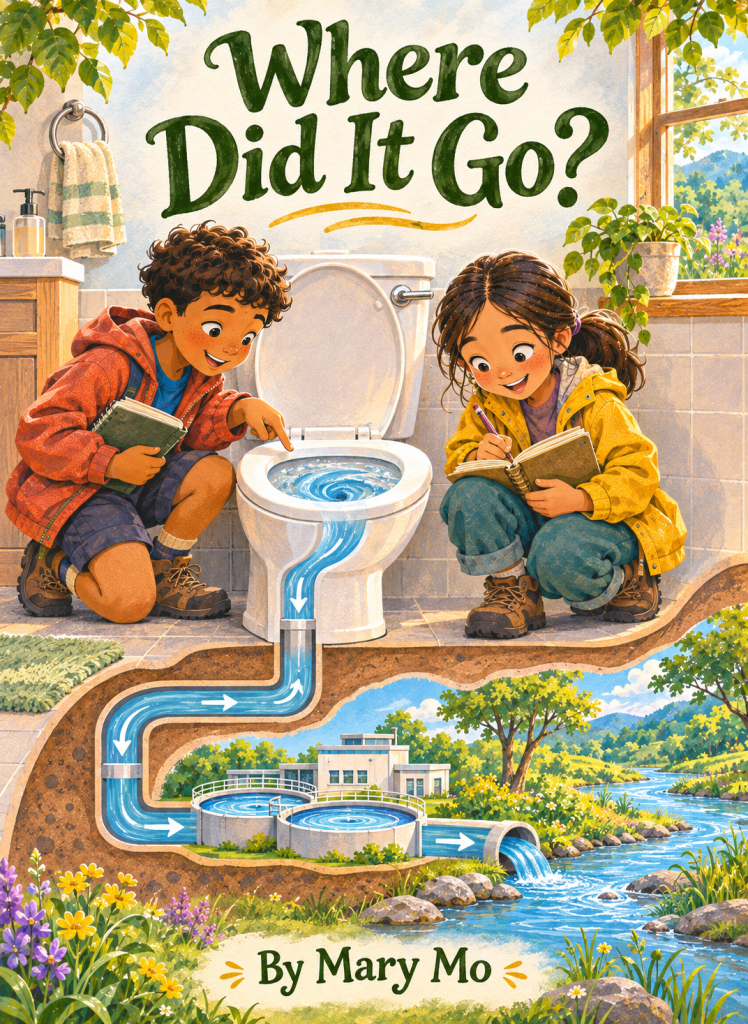
Where does toilet water go after you flush? In many neighborhoods, it travels through underground sewer pipes to a wastewater treatment plant. There, workers and equipment remove trash and solids, and several cleaning steps treat the water before it returns to the environment or is reused. Homes with septic systems follow a different route.
For a young child, the first answer can be wonderfully simple: “It went into a pipe. Let’s find out where that pipe leads.” The rest can become a small investigation you share together.
First stop: the pipes below the street
Flushing moves water and waste out of the toilet and into a pipe connected to the home. In a community sewer system, that pipe joins a larger network under the street. Gravity helps move wastewater along; some places also use pumping stations when the route needs a lift. Water from sinks, showers, and washing machines may join the same journey.
A child may imagine the pipe as a secret tunnel. That is a useful starting picture, as long as you explain that the real route depends on where you live. A town map or a local water utility’s website can help you discover your own community’s path.
What happens at a wastewater treatment plant?
A treatment plant does much more than give dirty water one giant rinse. The exact process varies, but common steps include:
- Screening: bars or screens catch large items that should not have been flushed.
- Settling: heavier solids can sink while other material is removed from the water.
- Biological treatment: helpful microorganisms break down some of the remaining waste.
- Final treatment and testing: the plant follows local rules before treated water is released or reused.
The material separated from the water is handled through its own treatment process. It does not simply travel unchanged from the toilet into a river.
Where does the water go next?
After treatment, water may return to a river, lake, or coastal waterway. Some communities reuse treated water for purposes such as irrigation. This is not the same as saying that toilet water becomes drinking water after one stop: drinking-water systems have their own sources, treatment requirements, and safeguards.
Children often want one neat answer, but “it depends on our town” is an honest and interesting answer. The route in a story can show one possible system while inviting families to investigate their local one.
What if our home has a septic system?
Not every home connects to a public sewer. A home with a septic system sends wastewater to an on-site tank, where solids settle. The liquid then moves through a drainfield for further treatment in the soil. An adult can check which system serves your home; a child does not need to explore any equipment.
What should go in the toilet?
A good family rule is to flush pee, poop, and toilet paper. Wipes, paper towels, toys, and other objects belong elsewhere, even when a package uses the word “flushable.” Those items can block pipes or cause trouble at a treatment plant.
Try a two-minute “follow the flush” activity
Draw a house at one edge of a page. Let your child draw a winding line beneath a street, then add a place where water could be cleaned and a waterway beyond. Ask: “Which part is hidden? Who helps take care of it? How can we find out what happens in our town?”
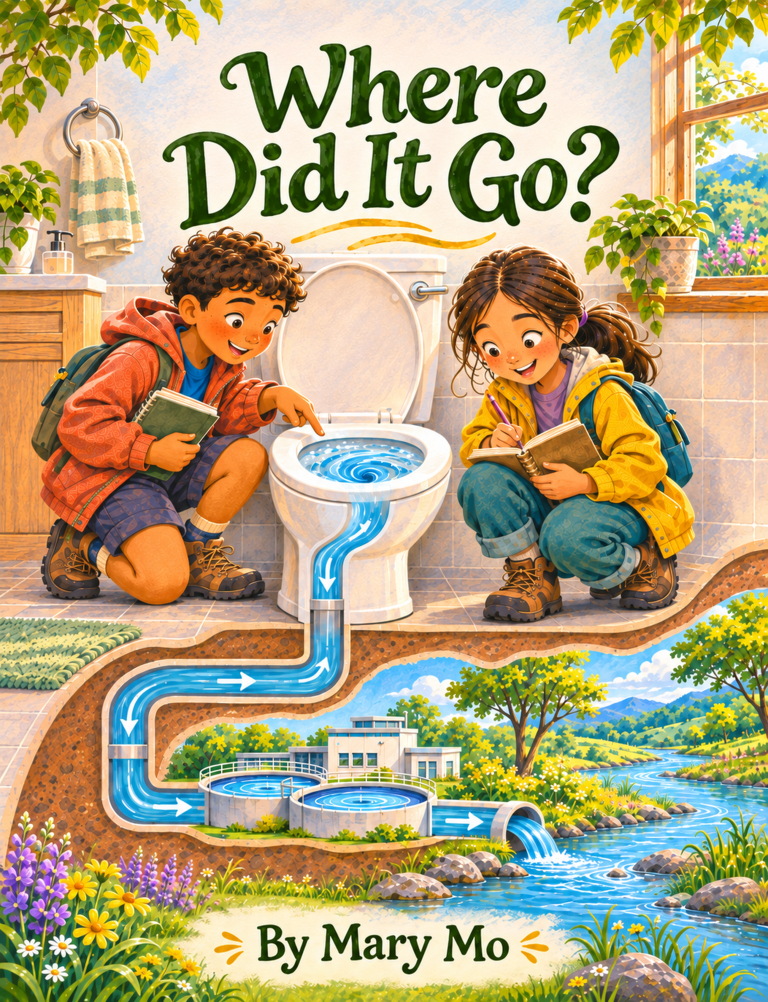
For a story version of that question, meet Pip and Kit in Mary Mo’s illustrated book Where Did It Go? They follow one mysterious flush through the places and people behind an ordinary bathroom moment.
Everyday Science
Where Did It Go?
One flush sends Pip and Kit on a visual adventure through hidden pipes, a wastewater treatment plant, and the waterway beyond. A full-color picture book for curious children ages 3–8.